 blog
blog
Plastisol vs Water-Based Ink: Which Works Best
Table of Contents
- What Are Plastisol and Water-Based Inks?
- Water-Based Ink vs Plastisol Feel: Print Hand and Comfort
- Durability, Wash Performance, and Colour Retention
- Screen-Printing Ink Curing: Methods and Troubleshooting
- How to Identify Plastisol Ink on a Shirt
- Environmental Impact and Cleanup Differences
- Making Your Choice: Cost, Workflow, and Fabric Fit
- Frequently Asked Questions
Last Updated: October 14, 2026
What Are Plastisol and Water-Based Inks?
Choosing between plastisol vs water-based ink for screen printing means choosing between two fundamentally different chemical formulations.
Plastisol ink is a suspension of PVC particles in a liquid plasticiser.
Water-based ink is a suspension of pigments in a water-based carrier.
The choice shapes how your prints feel, how long they last, how much cleanup you'll do, and your production workflow.
Water-Based Ink vs Plastisol Feel: Print Hand and Comfort
The most immediate difference is how the print feels on skin, what printers call "print hand."
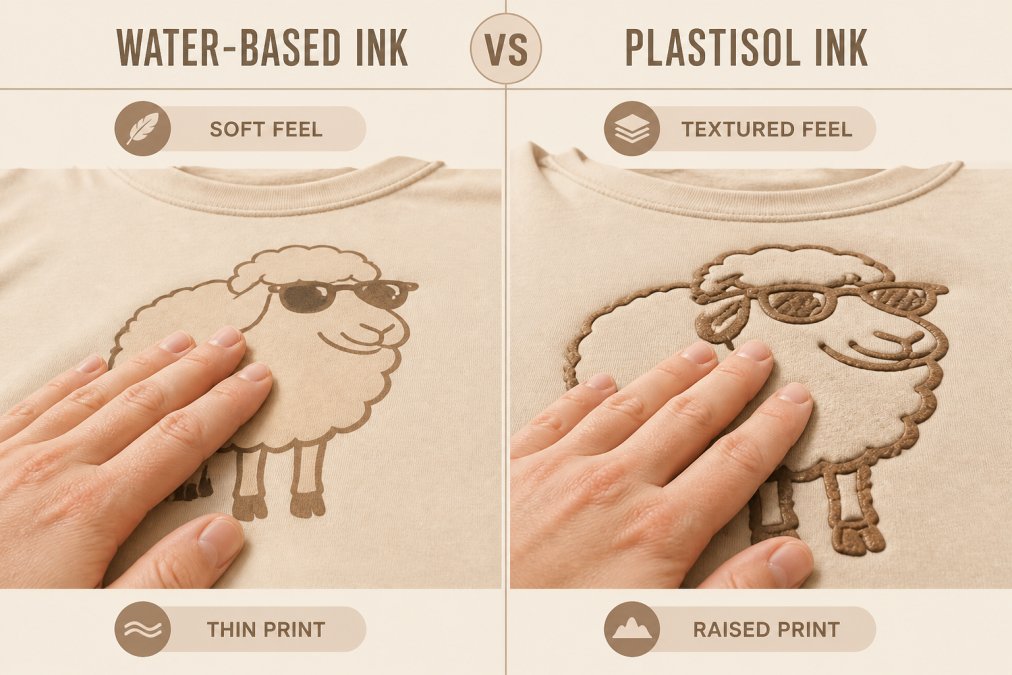
Water-based inks produce a "soft hand." The print sits closer to the fabric surface in a thin layer that moves with the garment, feeling almost like part of the fabric itself. This matters for everyday wear, especially for people sensitive to printed designs or who prefer a t-shirt's natural drape.
Plastisol creates a heavier deposit. The cured ink sits on top of the fabric rather than bonding into it, producing a "thick hand" or "raised print" you can feel clearly.
Breathability follows from thickness. Water-based prints let air pass through more freely; plastisol's thicker deposit can make garments feel warmer in hot weather.
Durability, Wash Performance, and Colour Retention
Here's where the two inks reveal their real strengths and weaknesses.
Plastisol durability is legendary. Properly cured, plastisol resists washing, fading, and cracking, surviving hundreds of washes.
The catch is curing.
Water-based ink durability depends heavily on formulation and curing.
In practice, water-based inks need careful attention to drying time and conditions: adequate air drying, humidity management, and sometimes gentle heat.
| Durability Factor | Plastisol | Water-Based |
|---|---|---|
| Wash fastness (properly cured) | Excellent | Very good to excellent |
| Crack resistance | Excellent | Good to excellent |
| Colour retention | Excellent | Very good |
| Sensitivity to under-curing | High | Very high |
| Best for | High-volume, heavy-use garments | Custom orders, comfort-focused pieces |
Screen-Printing Ink Curing: Methods and Troubleshooting
Curing is where the two inks diverge most in workflow and equipment, and where most print failures originate. Plastisol cures by fusion; water-based ink cures by evaporation and oxidation. Different processes fail differently and need different diagnostics.
Plastisol: fusion curing
Plastisol must reach a specific ink-film temperature, not just a surface temperature, for the PVC particles to fuse. Most practitioners target roughly 160°C to 180°C at the ink film, held long enough for heat to penetrate the full deposit.
A common mistake is trusting the dryer's display as the ink temperature. It isn't: the chamber may read 170°C while the ink film sits at 130°C because the belt runs too fast or the garment passes too far from the element.
Typical plastisol failure modes and their fixes:
- Under-cure (tacky feel, cracks after a few washes): the ink film never reached fusion temperature. Increase dwell time first, then temperature. Re-check with a probe rather than guessing.
- Scorching or over-cure (brittle, discoloured, cracked in wear): the ink film exceeded the upper end of the window or sat in the heat too long. Reduce temperature or belt time. Scorching is more common on light-coloured garments where discolouration is visible.
- Uneven cure (some areas fuse, others do not): usually a heat-distribution problem. Check flash-dryer distance, conveyor belt alignment, and whether the garment is sitting flat. A folded sleeve can shadow part of the print.
- Ghosting or dye migration on polyester: heat that is high enough to cure can also mobilise disperse dyes in the fabric. This is a fabric problem as much as a curing problem, and it is covered in the fabric section below.
Water-based: evaporation and oxidation
Water-based ink sets as the water carrier leaves the film and the binder oxidises. It's slower and needs lower peak temperatures, but it's more sensitive to ambient conditions.
Air drying works for small runs, but most shops use gentle heat, often 60°C to 80°C, to drive off moisture without plastisol's intensity. The trade-off is time: a full dry-and-oxidise cycle always takes longer than a plastisol print that fuses in seconds.
Typical water-based failure modes and their fixes:
- Incomplete drying (stiff or sticky print, colour not fully set): extend drying time or add gentle forced air. Do not stack garments while still damp.
- Humidity interference (slow, inconsistent drying): improve ventilation, use a dehumidifier, or move drying to a controlled area. This is the most common cause of inconsistent results between seasons.
- Colour shift (print looks different wet versus dry): water-based inks often appear darker or more saturated when wet. Always assess colour after the print is fully dry, not straight off the screen.
- Wash-out after first wash: usually under-oxidation rather than under-drying. The film felt dry but the binder had not fully set. Give it more time, not just more heat.
How to Identify Plastisol Ink on a Shirt
If you're buying graphic tees or evaluating quality, spotting plastisol ink is useful.
Feel the print first. Plastisol feels raised and textured, almost three-dimensional, with clearly defined edges.
Look at the edges. Plastisol prints have crisp, defined edges and sit on the fabric like a sticker.
Check the back of the garment. Inside out, plastisol shows a clear, opaque ink layer.
Assess breathability. Hold a large print up to light.
Environmental Impact and Cleanup Differences
If sustainability matters, the environmental profiles differ significantly, but 'water-based is greener' is too blunt. The real comparison depends on formulation, wastewater handling, curing, and how long the garment lasts.
Plastisol: the PVC and plasticiser question
Plastisol's footprint centres on PVC and its plasticisers. PVC production is energy-intensive and involves chlorinated chemistry, and some traditional plasticisers raise persistence concerns. Plastisol-contaminated screens, tools, and waste ink need care: never down a standard drain, and many workshops treat it as controlled waste.
The counter-argument is durability. A plastisol print surviving hundreds of washes keeps a garment in service longer, spreading its embodied carbon over more wears.
Water-based: better chemistry, but not automatically lower impact
Water-based inks are generally free of PVC and plastisol's plasticisers, and they clean up with water rather than solvent: less solvent exposure, simpler screen reclaim, and no aggressive cleaning chemicals to store and dispose of.
But three qualifications matter:
- Formulation varies. 'Water-based' covers a wide range, from simple pigment-and-binder systems to high-solids and hybrid formulations that may include small amounts of co-solvents or crosslinkers. Two water-based inks from different suppliers can have quite different profiles. Ask for the safety data sheet rather than assuming.
- Wastewater is not automatically safe. Rinsing pigment-laden water down the drain is not the same as rinsing clean water. Pigments, binders, and any additives still need to be managed. Many shops use a settling tank or filtration before disposal, and some local water authorities require it. Check what applies to your premises rather than assuming water-based equals drain-safe.
- Curing energy counts. Water-based inks need longer drying and oxidation, which means more time under heat or in a drying tunnel. In a high-volume shop, the energy used to dry water-based prints can offset some of the chemistry advantage. In a small shop air-drying at room temperature, the energy penalty is minimal.
Cleanup and equipment maintenance
Cleanup shows the day-to-day difference. Plastisol doesn't dry in the screen, so you can leave one loaded overnight and reclaim later with solvent or press wash.
For a small or home setup, water-based cleanup is a clear win on convenience and on what you are breathing in. For a high-volume shop running plastisol, the solvent handling is a known, managed cost rather than a surprise.
The honest summary
Water-based inks have the better chemistry and cleanup story. Plastisol has the better durability story, which can mean lower impact per wear on garments worn hard. Neither claim survives without qualification; the answer depends on your volume, drying setup, and how customers use the garments.
Making Your Choice: Cost, Workflow, and Fabric Fit
The decision between plastisol vs water-based ink depends on three factors: your production workflow, your target garment, and what your audience values.
Choose plastisol if:
- You're printing high volumes and need fast, reliable curing
- Durability is the priority, work uniforms, athletic wear, pieces meant to last years
- You have proper heat-curing equipment and can control temperature precisely
- Your designs benefit from a raised, textured appearance
- You're printing on dark fabrics where opacity matters
Choose water-based if:
- You're doing custom orders or smaller runs where you can manage drying time
- Comfort and soft hand are priorities, everyday wear, gifts, sensitive-skin wearers
- You want easier cleanup and lower environmental impact
- You're printing on lighter fabrics where breathability matters
- Your audience values the feel of the garment as much as the design
The real mistake is choosing one ink for every job. The best printers use both, selecting by garment, design, and intended use. A limited-edition funny tee for everyday wear? Water-based. A work shirt that must survive hundreds of washes? Plastisol.
Frequently Asked Questions
Which is better, plastisol or water-based ink?
Neither is universally better, it depends on your priorities. Plastisol ink offers superior durability, bright colours, and handles dark garments well, but leaves a thicker feel and requires chemical cleanup. Water-based ink feels softer, breathes better, and is easier to clean with water, but requires careful curing and may show colour fading faster on dark fabrics. Choose plastisol for high-volume orders and heavy-wear garments; choose water-based for comfort-focused designs and eco-conscious production.
How can you tell if a print uses plastisol or water-based ink?
Feel the print first: plastisol has a noticeably raised, plastic-like texture that you can feel and see from the side. Water-based ink sits flatter and feels softer, almost like part of the fabric. Look closely at the edges, plastisol prints have crisp, defined borders, while water-based prints may have slightly softer edges where the ink has absorbed into the fabric. Wash the shirt; plastisol holds its shape and colour through many cycles, whilst water-based ink may show slight fading or edge softening sooner.
Do plastisol and water-based inks need different curing methods?
Yes, significantly. Plastisol requires heat curing, typically using a flash dryer or conveyor dryer at 150-160°C for 3-5 seconds, or an oven at similar temperatures. Water-based ink can air-dry but cures faster with heat (60-80°C for 1-2 minutes) and reaches full durability only after a hot wash cycle. Undercuring either ink results in poor durability and colour loss, so method and temperature matter for both.
What are the downsides of using water-based ink?
Water-based ink requires precise moisture control during printing, too much humidity causes bleeding and poor detail. Curing is more demanding; undercured prints crack or fade quickly. The ink is less opaque, so printing white or bright colours on dark garments is difficult without multiple passes. Cleanup is easier, but the ink dries quickly on screens, requiring frequent flushing and careful screen management. It's also less forgiving for beginners compared to plastisol's straightforward heat-cure process.
Choosing the right ink comes down to understanding what you're printing, who's wearing it, and how it will be used. If you're looking for comfortable, durable statement pieces with original designs that actually make people laugh, Baaaad Flockers combines quality printing with over 30 years of design expertise to ensure your tee feels as good as it looks. Explore our collection of humorous, hand-drawn designs backed by easy free 30-day returns.