 how-to
How to Mix Patterns for a Cohesive Everyday Look
Last Updated: November 6, 2026
Quick Summary
To mix patterns for a cohesive everyday look, start with a neutral solid foundation, repeat two or three shared colours across both prints, and pair one large-scale pattern with one small-scale pattern. Add texture or a solid buffer between prints so the eye knows where to land first.
- Start with two solids and one pattern, then add a second print once that feels natural.
- A shared colour across both patterns is the glue that makes prints look cohesive.
- Pair a fine Breton stripe with a large floral skirt for a reliable combination.
- Keep the stripe on one half of the body and the floral on the other.
- Two prints is the safe ceiling for most people, so build one formula fully first.
Table of Contents
- Start With a Neutral Foundation Before You Mix Patterns
- The Beginner-Friendly Step-by-Step Method for How to Mix Patterns
- How to Balance Patterns in an Outfit Without Clashing
- How to Wear Stripes and Florals Together
- Pattern Mixing Outfit Ideas for Everyday Wear
- Common Pattern Mixing Mistakes and Quick Fixes
- Find a Statement Tee That Works With Your Patterns
- Frequently Asked Questions
Start With a Neutral Foundation Before You Mix Patterns
Most pattern mixing goes wrong before a single print is chosen. The problem is the base layer, not the bold layer.
A neutral foundation means building your outfit around solid colours first: plain denim, a white tee, a grey knit, black trousers, a cream jacket. These pieces give your eye somewhere to rest. Then the patterns become the interesting part rather than the overwhelming part.
Statement pieces work best with a calm backdrop. A loud graphic tee on top of loud trousers fights itself. The same tee over plain jeans looks deliberate.
Why Solid Colours Make Patterned Pieces Easier to Wear
Solid colours do one job well: they let a patterned piece be the focal point.
- A white tee under a checked shirt keeps the outfit readable
- Plain jeans let a floral jacket lead
- A neutral knit stops a busy skirt from shouting
Think of solids as the frame and patterns as the picture. Remove the frame and the picture has nowhere to sit.
Start with two solids and one pattern for your first few attempts. Once that feels natural, add a second print.
The Beginner-Friendly Step-by-Step Method for How to Mix Patterns
Here is a simple method for anyone nervous about print mixing. It works with clothes you already own.
Step 1: Pick your colour story. Choose two or three colours that already appear in your wardrobe and repeat them across both patterns. A shared colour is the glue. If your floral shirt has a rust tone, find a check or stripe with that same rust in it. A shared colour is one of the most effective ways to make prints look cohesive.
Step 2: Vary the pattern scale. Pair one large-scale print with one small-scale print. A big floral skirt with a fine stripe top reads as balanced. Two large prints compete. Two tiny prints blur into mush from a distance.
Step 3: Add texture and accessories. Texture separates patterns visually without adding more print. Knitwear, denim, corduroy, leather and woven fabrics all do this work. Accessories are the easiest entry point: a patterned sock, a striped scarf, a checked bag. Colourful socks are a low-risk way to test pattern mixing before committing to a full outfit. If you want an easy starting pair, our Sheep Friends Aqua Bamboo Socks add colour and texture without dominating the look.
| Step | What You Do | Time | Why It Works |
|---|---|---|---|
| 1 | Pick a shared colour story | 1 min | Ties prints together |
| 2 | Vary pattern scale | 1 min | Creates visual balance |
| 3 | Add texture and accessories | 2 min | Separates prints without more pattern |
How to Balance Patterns in an Outfit Without Clashing
Balance in pattern mixing comes down to one principle: one print leads, the others support.
Give a single garment the job of focal point. Everything else plays a supporting role, either as a solid, a texture, or a quieter print. This is how you avoid the "I got dressed in the dark" effect.
A few practical rules we use:
- Contrast in scale, not in chaos. Large with small, dense with sparse.
- Repeat a colour, not a pattern. Two florals in the same colour family can work. Two florals in clashing colours rarely do.
- Use a solid buffer. Put a plain layer between two prints if they feel too close together.
- Check from a distance. Step back from the mirror. If the outfit reads as one blur, the scales are too similar.
The common mistake is treating balance as symmetry. It is not. Balance means the eye knows where to land first.
How to Wear Stripes and Florals Together
Stripes and florals are the classic pairing because they are opposites: geometric against organic, structured against soft. But the difference between a stylish outfit and a busy one comes down to three measurable choices, scale, colour and placement.
Scale. Pair a fine stripe with a large floral, or a bold stripe with a small ditsy floral. The ratio matters more than the pattern itself. A fine Breton stripe (roughly 5-10mm bands) with a large floral skirt (flowers the size of your palm or bigger) is a reliable combination.
Colour. Pick a stripe that contains one colour from the floral, or the reverse. Navy stripes with a navy-toned floral is almost foolproof. If the floral has a rust centre, look for a stripe with a rust band. This single move does more for cohesion than any other rule. If you cannot find an exact match, choose a stripe in a neutral (navy, black, cream, grey) and let the floral carry the colour.
Placement. Keep the stripe on the top half and the floral on the bottom half, or the reverse. Putting both prints on the same half of the body, a striped top and a floral jacket, for example, compresses the visual interest and makes the outfit feel top-heavy. A plain layer between them, such as a solid cardigan or a denim jacket, gives the eye a rest and separates the two patterns.
A worked example. Fine navy-and-white Breton stripe long-sleeve top, large-scale navy-and-cream floral midi skirt, plain navy cardigan worn open, plain white trainers. The stripe is small, the floral is large, the navy repeats across both, and the cardigan is a solid buffer. This is a reliable formula to copy.
If you want a ready-made patterned piece for this look, our Mad Moose R Stripey Rugby Shirt gives you the stripe side of the equation already sorted, so you only need to add the floral.

Watch out: a bold wide stripe with a dense ditsy floral in clashing colours is the most common way this pairing fails. If the outfit looks like it is vibrating, swap the stripe for a finer version or change the floral to a larger scale.
Pattern Mixing Outfit Ideas for Everyday Wear
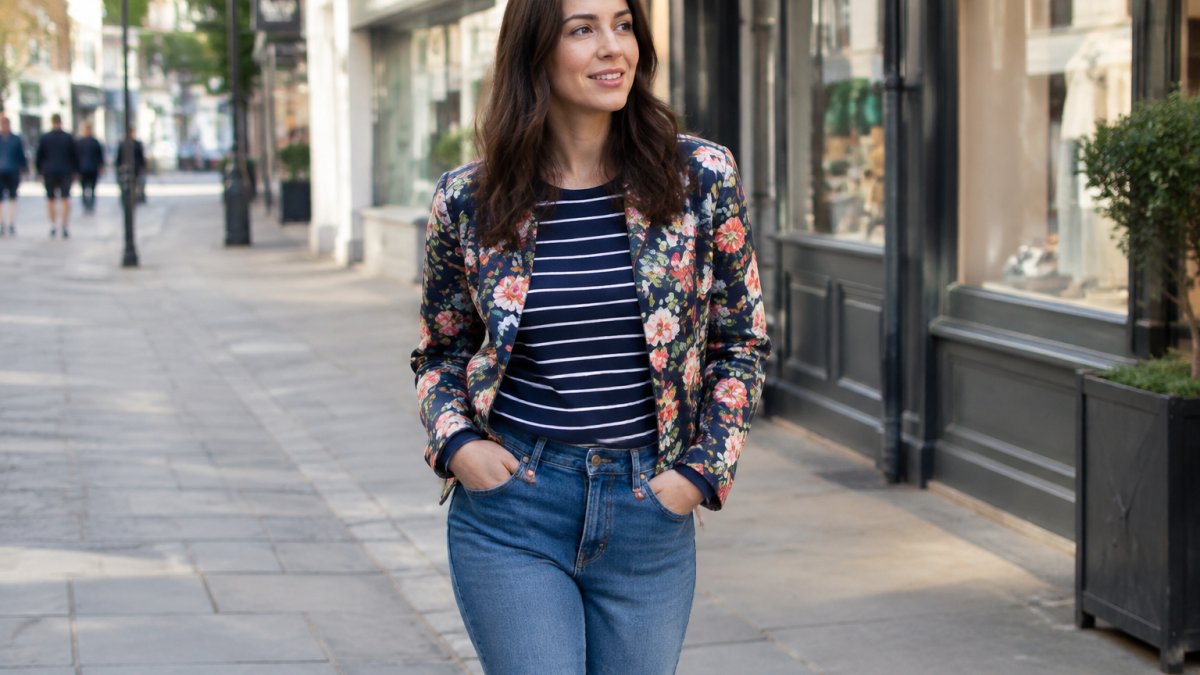
A formula is only useful if you can picture it on a real morning. Below are five complete outfits, each with the exact pattern pairing, the solid pieces that hold it together, and the setting it suits. Every one uses two patterns maximum and at least two solids.
1. The office-safe stripe and check. Start with a fine navy-and-white Breton stripe top. Layer a small-scale grey check blazer over it, then add plain navy trousers and black loafers. The shared navy is the glue; the check is small enough that it reads as texture from across a desk.
2. The weekend floral and stripe. Take a large-scale floral midi skirt in a rust-and-cream palette. Pair it with a fine cream-and-rust stripe tee, plain denim jacket, and white trainers.
3. The animal-print neutral. Leopard-print ankle boots behave like a solid when everything else is quiet. Wear them with a plain black knit, plain black trousers, and a small-scale grey polka-dot scarf. The scarf adds a second print without competing because it is tiny and tonal.
4. The geometric and organic mix. A polka-dot blouse in cream and forest green over an organic leaf-print skirt in the same forest green. Add a plain cream cardigan and plain brown boots. Two prints, one shared colour, one geometric and one organic.
5. The accessory entry point. All solids: plain white tee, plain blue jeans, plain grey overshirt. Then add one patterned bag or scarf in a colour that repeats a tone already in the outfit.
For a casual everyday version of outfit two, a practical backpack finishes the look without adding print. Our FLOK-Q 20L Backpack comes in three colours, so you can pick one that repeats a tone already in your outfit.
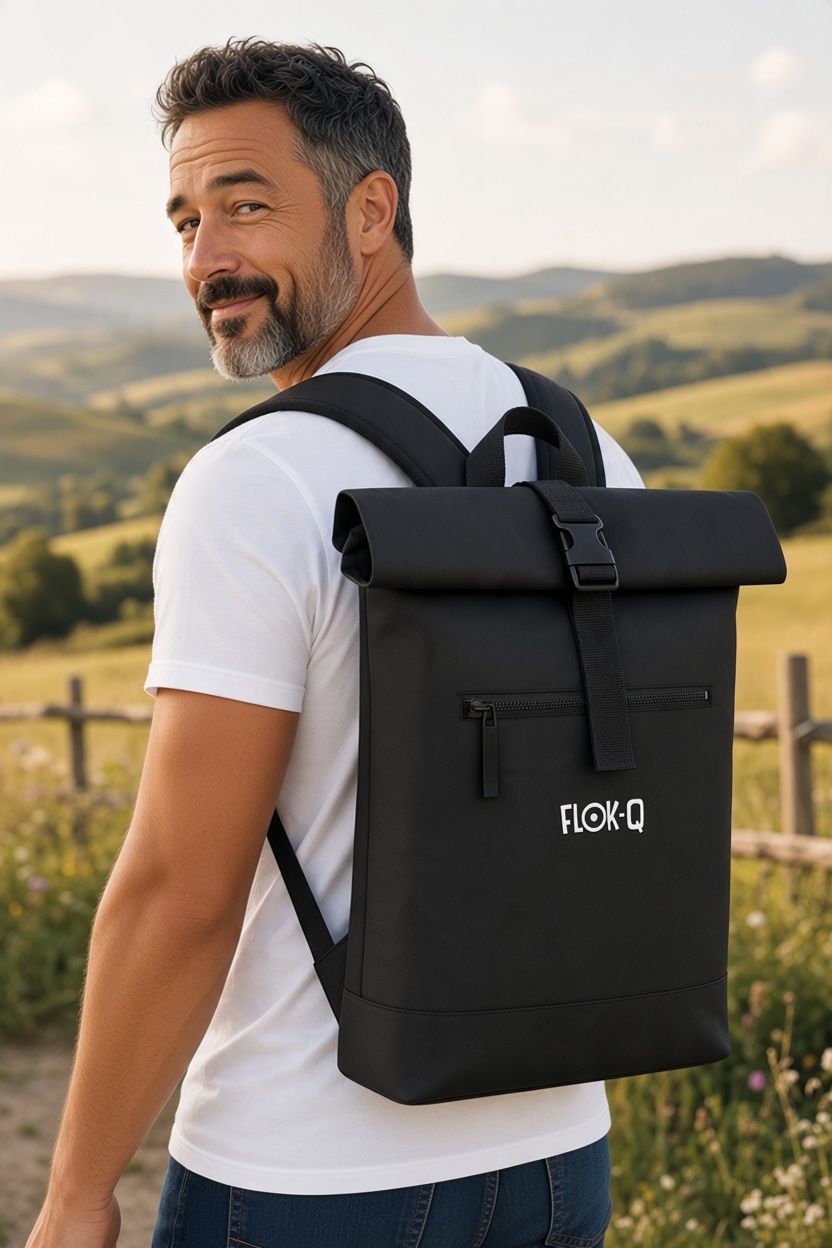
Watch out: if you try to combine three of these formulas at once, say a striped top, a floral skirt and an animal-print bag, the outfit stops reading as deliberate. Pick one formula and build it fully before adding a third print.
Common Pattern Mixing Mistakes and Quick Fixes
Most pattern mixing problems have a fast fix. Here are the ones we see most.
- Too many prints at once. Fix: remove one print and replace it with a solid.
- Matching scales. Fix: swap one print for a much larger or much smaller version.
- No shared colour. Fix: add a solid layer in a colour that appears in both prints.
- Forgetting texture. Fix: swap a smooth piece for knit, denim or corduroy.
- Over-accessorising. Fix: keep jewellery plain when the outfit already has two prints.
Watch out: mixing three or more bold prints in unrelated colours is the fastest route to an outfit that looks accidental rather than styled. Two prints is the safe ceiling for most people, and there is no shame in staying there.
Find a Statement Tee That Works With Your Patterns
A graphic tee is the easiest way to add personality without adding another print. Worn under an open checked shirt or a floral jacket, it becomes the calm centre of a patterned outfit.
The key is choosing a tee with a single strong image and a plain background. That way it reads as a focal point rather than competing with your prints.
Our Baaad Hair Day Graphic T-Shirt is a good example: one hand-drawn chest print on a heavyweight tee, available in sizes S to 5XL. If you prefer something with a bit more attitude, the Mooody Swings T-Shirt does the same job with a quirkier design.
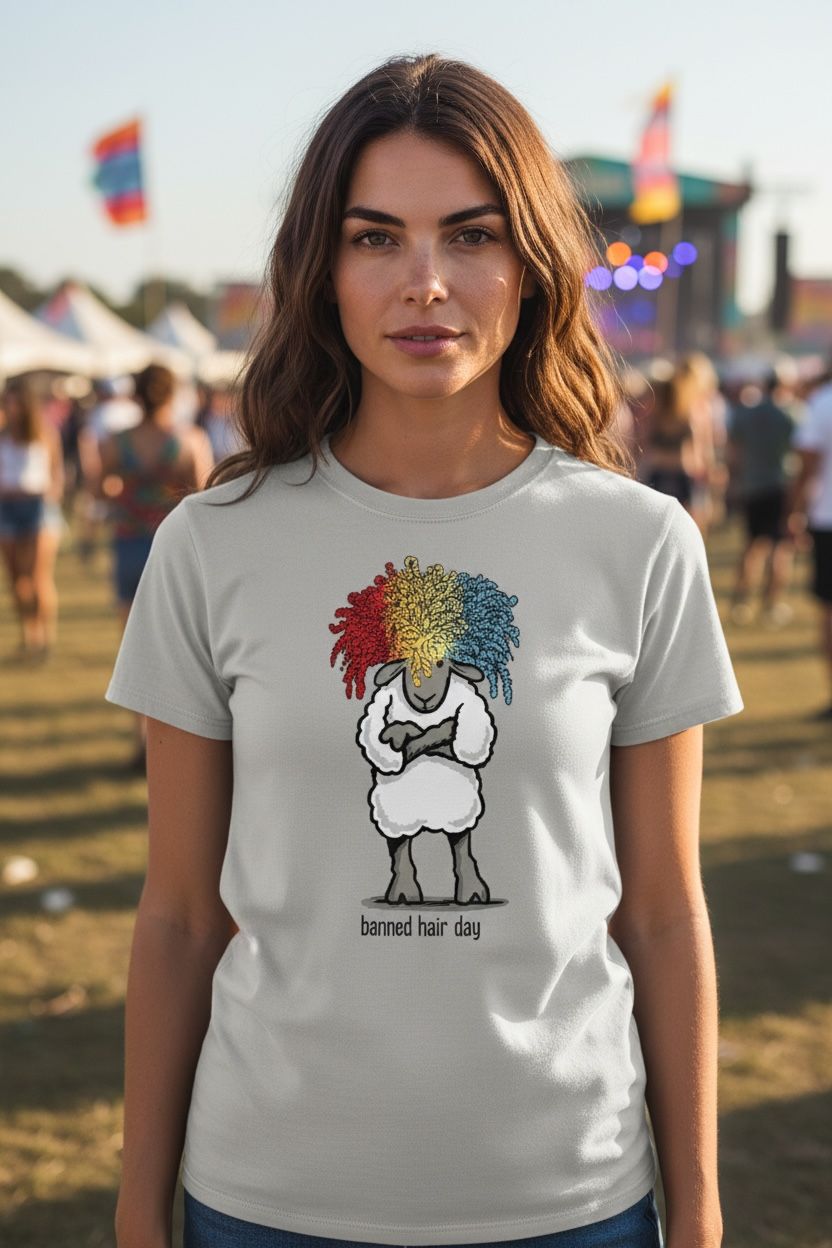
A bold design on a simple backdrop is the principle of pattern mixing in one garment.
Pattern mixing rewards a little planning and a lot of nerve. Start with a neutral base, pick a shared colour, vary the scale, and let one piece lead. That is the entire method, and it works on a Tuesday morning as well as a night out.
Baaaad Flockers has over 30 years of design experience creating statement pieces, with original hand-drawn artwork and easy free returns. Explore our men's tees and find a piece bold enough to anchor your next patterned outfit.
Frequently Asked Questions
How do you mix patterns without clashing?
Keep one element shared between the prints, usually colour. Pick two patterns that both contain the same tone, such as navy or rust, then let the scale do the rest. A large floral with a small check works because the eye reads them as different layers rather than competition. Add a solid neutral piece, like plain jeans or a block-colour knit, to give the outfit somewhere to rest.
How many patterns should you wear at once?
Two is the comfortable starting point for most everyday outfits, and three works when one is small and subtle, such as a polka dot scarf or a striped sock. The trick is to vary the scale so each print has its own space. If every pattern is bold and large, the outfit becomes busy and the focal point disappears.
Can you mix stripes and florals together?
Yes, and it is one of the easiest combinations to wear. Stripes are structured and florals are organic, so they balance each other rather than compete. Choose a stripe in a colour pulled from the floral print, or keep one piece small-scale and the other large. A striped top under a floral dress or a floral shirt with striped trousers both work well.
What is the easiest way to start mixing patterns?
Begin with one patterned piece you already love and build around it using solid colours. Once that feels natural, add a second pattern in a different scale, such as a small check against a large print. Accessories are a low-risk way in: a patterned scarf or bag lets you test the look without committing to a full patterned outfit.