 blog
blog
Best Threadheads Alternatives for Funny Apparel in 2026
Table of Contents
- What to Look for in Funny Graphic T-Shirts UK Buyers Actually Rate
- Why High Quality Graphic Tees Outlast Cheap Alternatives
- Sizing and Fit: What to Check Before You Order Online
- Design Originality: Pop Culture, Dark Humour, and the 90s Aesthetic
- Sustainability and Ethical Sourcing in Funny Apparel
- Shipping, Returns, and Customer Satisfaction: What to Expect
- Caring for Your Graphic Tees So the Print Survives
- Conclusion
- Frequently Asked Questions
Last Updated: September 13, 2026
What to Look for in Funny Graphic T-Shirts UK Buyers Actually Rate
If you're hunting for the best threadheads alternatives for funny apparel, the search usually starts the same way: you want a design that lands, a shirt that survives the wash, and a fit that doesn't betray you. At Baaaad Flockers, we've spent years watching people buy novelty tees on impulse and regret it by the second wash, so this guide focuses on the specs that actually matter. Below, we'll break down fabric weight, print method, sizing, and design quality so you can judge any brand on evidence rather than vibes.
Two things separate a shirt you wear weekly from one that becomes a dust cloth. Fabric weight, measured in GSM (grams per square metre), and print method. Everything else, from colour choice to humour style, sits on top of those two foundations.
Fabric Weight and GSM: The Spec Nobody Checks Until the Shirt Fails
Fabric weight is the single best predictor of how a graphic tee will feel and age. Lightweight cotton under roughly 150 GSM feels thin and tends to lose shape quickly. Midweight cotton in the 180-200 GSM range holds its structure, drapes properly, and takes a screen print without the design warping the garment.
Most retailers don't publish GSM at all. That omission tells you something. If a brand selling high quality graphic tees won't state the fabric weight, assume it's on the lighter end, because a heavier, better-made shirt is a selling point worth advertising.
Premium cotton matters here too. Combed or ring-spun cotton feels softer against the skin and resists pilling far better than standard carded cotton. When you're comparing funny graphic t-shirts UK shoppers keep coming back to, check the product page for both the weight and the cotton type before you check the design.
A common mistake is buying on design alone. The design is why you click. The fabric is why you keep wearing it.
Print Method: Screen-Printed vs. Print-on-Demand
Screen printing and print-on-demand produce very different shirts, and the difference shows up within months. Screen-printed designs push ink into the fabric through a mesh screen, creating a thick, durable layer that bonds with the cotton. Print-on-demand, where a design is printed only after an order is placed, is cheaper to run but typically uses a thinner transfer or direct-to-garment process.
That thinner print is where cracking starts. Direct-to-garment prints sit on top of the fabric rather than bonding into it, so they flex and split as the shirt stretches and washes. Screen-printed ink moves with the garment.
For niche apparel with original, artistic prints, screen printing also holds colour depth better. Bold, hand-drawn linework stays crisp. Faded, patchy prints are almost always a sign of a cheap transfer method rather than a design choice.
Here's the trade-off worth understanding:
| Print Method | Durability | Colour Depth | Best For |
|---|---|---|---|
| Screen-printed | High, survives many washes | Bold, saturated | Original designs, small runs |
| Direct-to-garment | Moderate, can crack | Softer, less vivid | Photo prints, one-off orders |
| Heat transfer | Low, peels over time | Sharp initially | Short-term novelty items |
Why High Quality Graphic Tees Outlast Cheap Alternatives
The maths of cheap tees rarely works in your favour. A shirt that fades or cracks after a handful of washes gets replaced, and the replacement costs the same again. A well-made tee that holds its print for years spreads its cost across every wear.
This is the argument for paying attention to garment quality rather than headline price. It's also why fit notes and fabric softness matter as much as the joke on the front. You're buying a piece of clothing, not a poster.
Ink Durability and Wash Resistance
Wash resistance comes down to how the ink was applied and how you treat the shirt afterwards. Screen-printed designs with a proper cure survive dozens of wash cycles with minimal fading. Transfers and direct-to-garment prints degrade faster, especially in hot water or a hot tumble dry.
The practical test: turn a shirt inside out, wash it cool, and air dry it. Do that and even a mid-range print lasts considerably longer. Ignore it and even good ink suffers.
Look for brands that state their print longevity or offer a returns window long enough to actually test a shirt. A generous return policy signals confidence in the product. A generous return policy signals confidence in the product. Baaaad Flockers, for instance, offers easy free 30-day returns, which gives you room to wash and wear before committing.
Sizing and Fit: What to Check Before You Order Online
Fit is the number one reason online clothing gets returned, and graphic tees are no exception. Sizing varies between brands, between unisex and fitted cuts, and between garment weights. A heavy cotton tee fits differently from a lightweight one even when both are labelled the same size, because a stiffer 200 GSM fabric holds its shape while a 150 GSM fabric drapes closer to the body.
The practical fix is to stop trusting size letters and start working in centimetres. Every brand that takes fit seriously publishes a flat-lay measurement chart: chest width (measured pit-to-pit, then doubled), body length (from the highest point of the shoulder to the hem), and sleeve length. Compare those three numbers against a shirt you already own and like, laid flat and measured the same way. That single habit removes most of the guesswork.
Converting Sizes Between Markets
If you shop across international retailers, the size letters on the label mean different things in different places. A common pattern is that a US men's medium sits roughly one size larger than a UK medium, and an Australian medium often lands between the two (gov.uk). Women's cuts add another layer, because a US women's large can map closer to a UK women's medium or large depending on the brand's grading.
The only reliable method is to ignore the letter and match the centimetres. Build a small reference note on your phone with the pit-to-pit and body-length measurements of two shirts you wear often, then compare every chart against those numbers. If a brand publishes only S/M/L with no measurements, that is a reason to look elsewhere rather than gamble.
Unisex vs. Fitted Cuts
Unisex sizing is cut to sit between traditional men's and women's fits, which means it is usually boxier through the waist and longer in the body than a fitted women's tee. If you normally wear a fitted cut and order unisex, sizing down often gets you closer to the silhouette you want, but check the body length first, because sizing down also shortens the shirt. Fitted cuts run narrower through the chest and shoulder, so if you have broader shoulders, stay with unisex and check the chest measurement rather than the label.
Design Originality: Pop Culture, Dark Humour, and the 90s Aesthetic
Design originality is what stops a funny tee from looking like a copy of a copy. The strongest niche apparel brands draw on a recognisable visual language, whether that's pop culture references, dark humour, or the 90s aesthetic of bold graphics and retro styles, and then add something of their own.
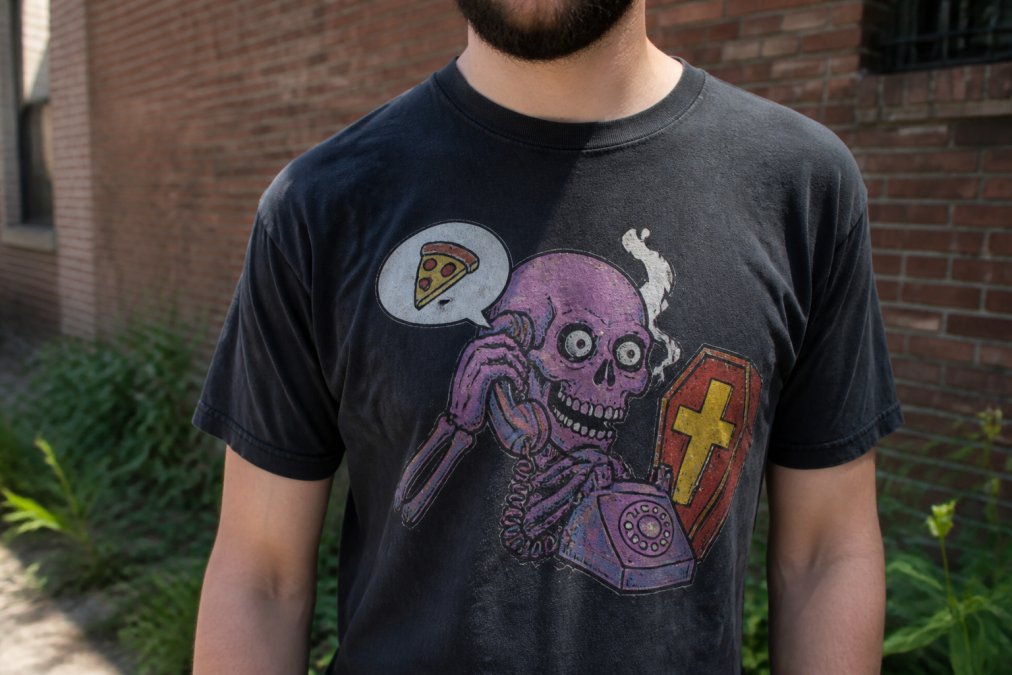
The difference between humour that lands and humour that cringes comes down to confidence. A design that's trying too hard reads as loud and try-hard. A design with a clear point of view reads as clever. Original hand-drawn artwork almost always beats a clip-art graphic dropped onto a blank.
If you're not normally a graphic tee person, start with a design that references something you already love rather than the loudest print on the page. Casual wear works best when the shirt feels like yours.
Sustainability and Ethical Sourcing in Funny Apparel
Ethical sourcing is increasingly a deciding factor for buyers, and it's one of the harder claims to verify. The problem is that 'sustainable' and 'eco-friendly' are used so loosely that they tell you almost nothing on their own. What separates a real claim from marketing is specificity: named fabric suppliers, a stated country of manufacture, and a clear description of the production process.
The Competition and Markets Authority guidance on green claims sets out what businesses can and can't say about environmental credentials, which is a useful benchmark for judging whether a brand's sustainability talk holds up. Under that guidance, vague or unverifiable claims risk being treated as misleading, so a brand that names its mill and its factory is doing so for a reason. If a claim is vague, treat it as marketing rather than fact.
The Durability Argument
Durable clothing is itself a sustainability argument, and it's the one buyers can actually verify. A shirt you wear for years uses fewer resources than five cheap shirts you replace. That is why print longevity and ethical sourcing are connected: both reward buying less, better. A screen-printed tee that survives dozens of washes is, in practical terms, a lower-impact purchase than a cheaper transfer print that cracks within a season, regardless of what either label claims.
What to Actually Check
- Named suppliers. A brand that states which mill spins its cotton and where the garment is cut and sewn is easier to hold to account.
- Fabric composition. Organic or recycled cotton content is a concrete, checkable claim, unlike a generic leaf logo.
- Print method. Screen printing with properly cured ink outlasts direct-to-garment and heat transfer, which means fewer replacements over time.
- Care guidance. A brand that publishes wash and care instructions is helping you extend the shirt's life, which is the most direct sustainability lever you control.
Shipping, Returns, and Customer Satisfaction: What to Expect
Shipping logistics and returns policy tell you how much a brand trusts its own product. A clear delivery timeframe, tracked shipping, and a returns window you can actually use are the baseline. A generous window, such as the free 30-day returns Baaaad Flockers offers, lets you test fit and print quality in real conditions.
Customer satisfaction in this category lives and dies on two things: whether the humour lands and whether the shirt holds up. Reviews that mention both the fit and the wash are the ones worth reading. Reviews that only say "great shirt" tell you nothing.
The Chartered Trading Standards Institute guidance on online shopping rights is worth a look if you want to know exactly what you're entitled to when an order arrives wrong or late. Knowing your rights makes you a sharper buyer.
| What to Check | Why It Matters | Red Flag |
|---|---|---|
| Delivery timeframe | Sets expectations | "Ships soon" with no date |
| Returns window | Lets you test quality | No returns on sale items |
| Tracked shipping | Protects your order | Untracked only |
| Review detail | Reveals real quality | Only one-line reviews |
Caring for Your Graphic Tees So the Print Survives
Care instructions are the cheapest way to extend a shirt's life, and most people ignore them. Wash inside out in cool water, skip the fabric softener, and air dry where you can. Heat is the enemy of every print method, so a hot tumble dry is what cracks a design that would otherwise last.
Turn the shirt inside out before it hits the machine. This protects the print from rubbing against other garments. Wash with similar colours and avoid overloading the drum.
For screen-printed shirts, iron on the reverse only, never directly on the design. A little care adds years to a shirt, and years of wear is what makes a good tee worth its price.
Conclusion
Finding funny apparel that survives real life comes down to checking the specs most shoppers skip: fabric weight, print method, and fit. Once you know what to look for, the choice gets a lot easier. Baaaad Flockers brings 30+ years of design experience, original hand-drawn humour that's funny without being vulgar, high-quality garments with a genuinely good fit, and easy free 30-day returns, plus premium coffee beans for good measure. Explore Men's Tees and find a shirt that earns its place in your wardrobe.
Frequently Asked Questions
What should I look for when buying high-quality graphic apparel?
Check the fabric weight (GSM), print method, and sizing details before you buy. Heavier cotton (180-220 GSM) holds shape and feels softer over time. Screen-printed ink lasts longer than heat-transfer prints. Look for brands that publish clear fit notes and offer easy returns, so you can order with confidence.
Are there UK-based alternatives for humorous clothing that ship quickly?
Yes. Several UK brands specialise in funny apparel and ship domestically, which cuts delivery times and avoids customs delays. Look for clear shipping timelines and free returns. Baaaad Flockers, for example, offers easy free 30-day returns and ships from the UK, so you can try a design risk-free.
How do I stop my graphic tee print from cracking after a few washes?
Wash inside out in cold water and avoid tumble drying. The heat from a dryer breaks down the ink bond faster than anything else. Hang dry when you can. Also check the print method before buying: screen-printed designs generally outlast heat-pressed ones. If a brand mentions wash resistance, that's a good sign they've tested it.
What makes a t-shirt brand stand out for its humour?
Originality and timing. The best funny apparel lands because the joke feels fresh and personal, not recycled. Hand-drawn designs tend to stand out more than stock graphics. Brands that avoid vulgarity while still being edgy also appeal to a wider audience, making them safer for gifting and everyday wear.