 listicle
Best Fabrics for Long-Lasting Graphic Shirts
Table of Contents
- Why Fabric Choice Matters for Graphic Shirts
- Cotton vs Polyester T-Shirt: Which Lasts Longer
- Most Durable T-Shirt Material: What the Research Shows
- Fabric That Holds Screen Printing: Print Longevity Matters
- How to Wash Graphic T-Shirts to Extend Print Life
- Key Fabric Qualities That Prevent Fading and Cracking
- Frequently Asked Questions
Last Updated: October 21, 2026
Why Fabric Choice Matters for Graphic Shirts
A graphic shirt either fades, cracks, and shrinks after a few washes or looks fresh months later, and choosing the best fabrics for long lasting graphic shirts makes all the difference.
At Baaaad Flockers, customers return to buy more graphic tees because they hold up, the secret is knowing which fabrics grip screen-printed designs best, resist shrinkage, and keep their shape.
Cotton holds ink beautifully but can shrink; polyester resists fading but feels less comfortable; blends split the difference.
Cotton vs Polyester T-Shirt: Which Lasts Longer
Cotton and polyester dominate graphic shirts, and they behave very differently on durability and print longevity.
100% cotton breathes, feels soft, and screen printing adheres to it naturally.
Polyester doesn't shrink and resists fading better than cotton because its fibres don't absorb dyes the way natural ones do. It dries faster and resists wrinkles, but pure polyester can feel plastic-like and doesn't breathe well in warm weather.
The honest answer: neither one is universally "better." Cotton wins on comfort and print feel. Polyester wins on durability and shape retention. That's why blends exist.
Most Durable T-Shirt Material: What the Research Shows
Durability isn't a fibre label, it's the sum of fibre quality, yarn construction, knit structure, and fabric weight. Judge a graphic shirt across five checkpoints: wash-cycle survival, pilling, abrasion at high-friction points, seam integrity, and colourfastness.
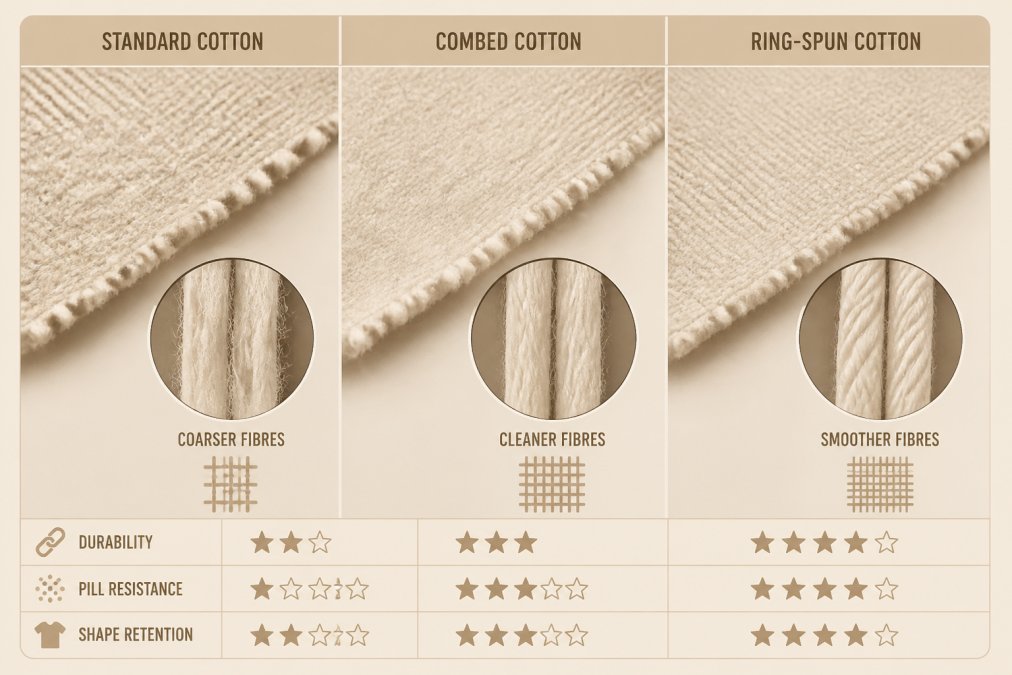
Combed and Ring-Spun Cotton
Combed cotton removes short fibres and impurities, leaving longer, stronger strands that resist pilling and hold colour better. Ring-spun cotton is twisted during production into stronger, finer yarn, so shirts feel smoother and last longer than standard cotton.
Both cost more than regular cotton but justify it.
If a product description just says "100% cotton," it's likely standard cotton; if it specifies combed or ring-spun, you're getting a better product.
Cotton-Polyester Blends
A cotton-polyester blend typically mixes 50% of each fibre, the sweet spot for most graphic shirts. Cotton provides comfort and breathability; polyester adds durability, shrink resistance, and colour retention.
Blends also hold screen printing better than pure cotton: polyester fibres give ink something stable to grip, so prints resist cracking.
The downside is minimal: blends aren't quite as soft as 100% combed cotton, but they dry faster and shrink less.
Tri-Blend Fabrics
A tri-blend combines three fibres, usually cotton, polyester, and rayon; rayon adds a silky feel and better drape, making tri-blends softer than standard blends.
For graphic longevity, tri-blends are middle-of-the-road: rayon doesn't aid print durability the way polyester does.
Tri-blends excel when comfort and aesthetics matter more than extreme durability, popular for fashion-forward designs where feel matters as much as the graphic.
How to Compare Fabrics on Measurable Wear
Instead of asking which fabric is "most durable," compare them on the criteria that actually predict failure:
- Wash-cycle survival: How many domestic washes before visible thinning, seam slippage, or print degradation? Ring-spun cotton and 60/40 blends generally hold shape longest; lightweight tri-blends show wear sooner.
- Pilling: Short-staple cotton and loose knits pill first. Combed, ring-spun, and tightly twisted yarns resist pilling because fewer loose fibres escape to the surface.
- Abrasion: High-friction zones (collar, underarm, side seams) reveal fabric quality. Heavier knits with tighter yarn twist abrade more slowly than thin, loosely knit jersey.
- Seam integrity: Double-needle stitched seams and taped necklines outlast single-stitch construction regardless of fibre. Check the inside of the shirt, not just the label.
- Colourfastness: Dark dyes on cotton can bleed in the first washes; polyester holds colour longer but can show shine at abrasion points. Blends balance both.
Fabric Construction and Quality Indicators
Beyond the fibre label, construction tells you most of what you need to know:
- Knit structure: Single jersey is standard for tees; interlock and heavier rib knits resist distortion better. A tighter knit gauge means less see-through and slower wear.
- Yarn type: Ring-spun yarn is smoother and stronger than open-end yarn. Carded cotton contains more short fibres and pills faster than combed.
- Fibre length: Long-staple cottons (such as Pima and Supima types) produce stronger, smoother yarn than short-staple varieties.
- Fabric weight: Measured in grams per square metre (gsm). Under 150 gsm is thin and print-fragile; 150-180 gsm is standard; 180-220 gsm is the durable sweet spot for graphics.
Sustainability and Lifecycle Trade-offs
Longevity is itself a sustainability argument, a shirt worn for years displaces several short-lived replacements. Cotton is water-intensive and can shrink; synthetics are petroleum-derived and shed microfibres but resist fading; blends are hard to recycle but durable. No fabric wins on every axis: choose the most durable construction you'll actually wear often, then care for it well.
| Fabric Type | Shrinkage Resistance | Print Longevity | Comfort | Best For |
|---|---|---|---|---|
| 100% Cotton | Low | Good | Excellent | Comfort-first wearers |
| Combed Cotton | Low | Very Good | Excellent | Premium cotton preference |
| Ring-Spun Cotton | Low | Very Good | Excellent | Durability + comfort balance |
| 50/50 Cotton-Polyester | Very High | Excellent | Good | Everyday wear and graphics |
| 60/40 Cotton-Polyester | Very High | Excellent | Very Good | Best all-around choice |
| Tri-Blend | Moderate | Good | Excellent | Fashion and feel-focused |
Fabric That Holds Screen Printing: Print Longevity Matters
Your graphic is only as durable as the surface it's printed on, and each print method fails differently on different fabrics. Mapping fabric to print method is the best way to predict cracking, peeling, or fading.
Screen Printing
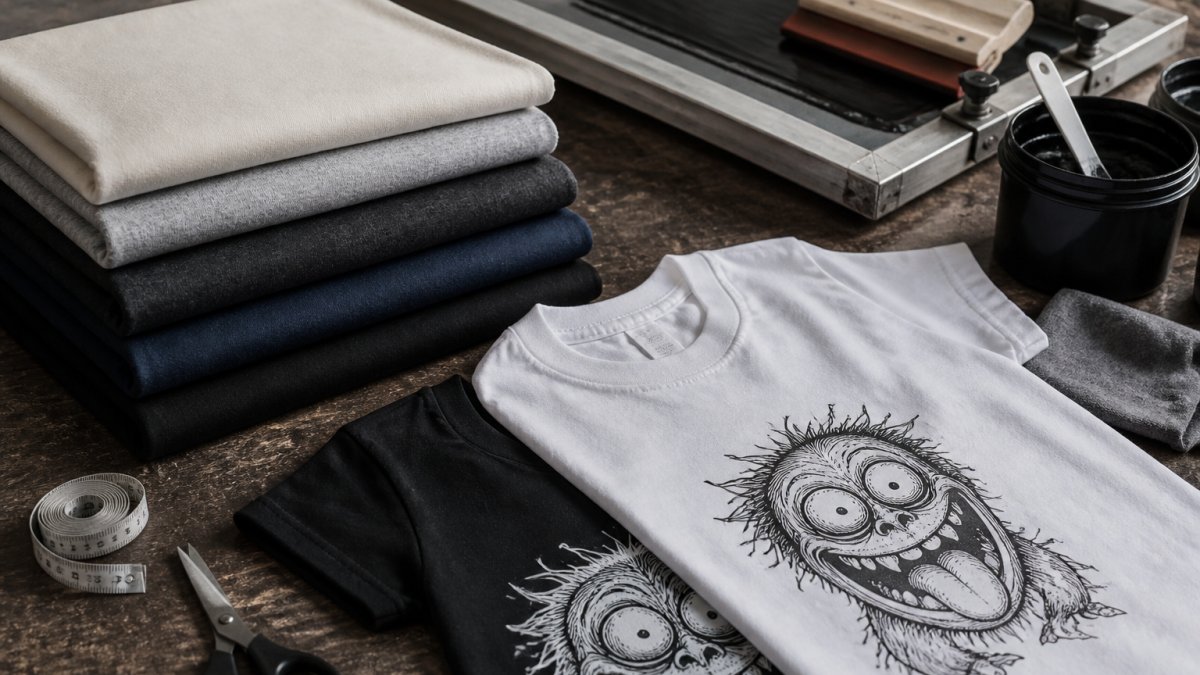
Screen printing presses ink through a mesh screen onto fabric, where it sits on top of the fibres and cures. The fabric needs texture and stability: smooth, slippery fabrics don't hold ink well, and rough, loose weaves let it seep in unevenly.
Cotton-polyester blends are ideal: cotton gives ink tooth to grip, and polyester provides stability so ink doesn't crack as the fabric flexes. Pure cotton prints soften faster; pure polyester feels plasticky under the print.
Likely failure modes: plastisol inks can crack along fold lines on stiff or very smooth fabrics; under-cured ink peels at the edges; dark inks on dark polyester can show a faint halo where the ink sits above the fibre.
Hoof Dares Wins T-Shirt | Funny Graphic T-Shirt | Baaad Flockers® →
Direct-to-Film (DTF)
DTF transfers a printed film onto the garment with heat and pressure. It adheres best to fabrics with a smooth, even surface and enough heat tolerance to bond without scorching.
- Best on: cotton, cotton-polyester blends, and polyester. Blends are often the most forgiving because the surface is consistent.
- Watch out on: loosely knit or heavily textured fabrics, where the transfer cannot make full contact and edges lift; and stretchy knits, where the film can crack if the adhesive is not matched to the fabric's stretch.
- Failure modes: peeling at the edges after repeated washing, cracking across the film on high-stretch areas, and a stiff hand-feel on heavy coverage.
Direct-to-Garment (DGT)
DGT prints water-based ink directly into the fabric, so it depends on the fibre absorbing the ink carrier. It is most reliable on cotton and high-cotton blends.
- Best on: 100% cotton and cotton-rich blends (roughly 60% cotton or higher). Ring-spun and combed cotton give a smoother, more even print.
- Watch out on: high-polyester fabrics, where the ink can pool, appear washed out, or fail to bond; and fabric with a heavy surface treatment or fabric softener residue, which blocks ink uptake.
- Failure modes: poor dye uptake and faded-looking prints on synthetics, plus wash-out on untreated polyester.
Sublimation
Sublimation turns solid dye into gas and bonds it into polyester fibres. It only works on polyester or polyester-rich blends with a high synthetic content, on cotton, the dye has nothing to bond to and washes straight out.
- Best on: polyester and high-polyester performance blends. The result is a print that becomes part of the fabric, so it does not crack or peel in the conventional sense.
- Watch out on: cotton and cotton-rich blends, where sublimation simply does not take; and very light polyester, where the heat press can leave shine marks.
- Failure modes: no adhesion on natural fibres; colour shift on heat-sensitive fabrics; ghosting if the press moves during transfer.
Fabric Weight and Surface
Heavyweight fabrics hold prints longer: a 180-200 gsm shirt gives more surface area for ink adhesion and resists the flexing that cracks prints, while lighter shirts (under 150 gsm) wear faster. A tight, even knit also prints more consistently than a slubby or loose one.
Baaaad Flockers uses premium heavyweight cotton and cotton-blend fabrics.
How to Wash Graphic T-Shirts to Extend Print Life
Even the best fabric and printing won't save a shirt you wash wrong.
Use cold water. Hot water makes dyes bleed and weakens fibres; cold water cleans just as effectively and extends the life of both fabric and print.
Wash with similar colours. Group shirts by colour family, especially in the first few washes when dyes are most likely to run.
Use mild detergent and skip fabric softener. Softener coats fibres and can make prints stiff or crack; a gentle detergent works best, and less is more.
Avoid the dryer. Heat cracks and fades prints.
Wash less frequently. Spot-clean stains and air the shirt out between wears to cut overall wear and extend the life of fabric and print.
Key Fabric Qualities That Prevent Fading and Cracking
Three qualities determine whether a graphic shirt fades and cracks prematurely.
Fabric weight is measured in grams per square metre (gsm).
Fibre length affects yarn strength.
Yarn twist determines how tightly fibres bind. Ring-spun yarn is twisted tighter than regular yarn, creating stronger, finer thread that resists pilling and holds its shape.
Together, high fabric weight, long fibres, and tight yarn twist resist fading and cracking far better than a cheap alternative, regardless of design quality.
Choosing the right fabric isn't just about comfort or cost, it's about keeping your favourite design vibrant through years of wear.
At Baaaad Flockers, we craft graphic shirts using premium heavyweight cotton and cotton-blend fabrics because durability matters.
Frequently Asked Questions
Which fabric is best for a graphic T-shirt?
Cotton and cotton-polyester blends are ideal for graphic T-shirts. Premium heavyweight cotton or cotton-blend fabrics provide excellent durability, hold screen-printed designs well, and offer comfort for everyday wear. Blends add wrinkle resistance and help prevent shrinkage, making them a practical choice for graphic shirts you want to last.
Does cotton or a cotton-polyester blend last longer?
Cotton-polyester blends typically last longer than 100% cotton. The polyester component increases durability, reduces shrinkage, and improves shape retention through multiple washes. While pure cotton offers superior softness and breathability, blends strike a balance between longevity and comfort, making them popular for graphic T-shirts designed to withstand regular wear.
What fabric holds printed designs best?
Heavyweight cotton and cotton-blend fabrics hold printed designs best. The denser weave provides a stable surface for screen printing ink to adhere properly, reducing cracking and peeling over time. Blends with polyester add extra resilience, helping the print maintain its shape and colour through repeated washing and wearing.
How should you wash a graphic T-shirt to make it last?
Wash graphic T-shirts inside out in cold water using a gentle cycle, and avoid bleach or harsh detergents. Dry on low heat or air dry to prevent print damage and fabric shrinkage. Minimise washing frequency by spot-cleaning when possible, and never iron directly over the printed design. These practices significantly extend both the garment and print lifespan.
What material shirt should resist shrinkage best?
Cotton-polyester blends resist shrinkage better than 100% cotton. The polyester content stabilises the fabric structure, preventing the significant shrinkage that pure cotton can experience, especially in hot water. Tri-blend fabrics, which combine cotton with polyester and rayon, also offer excellent shrinkage resistance whilst maintaining comfort and breathability.